
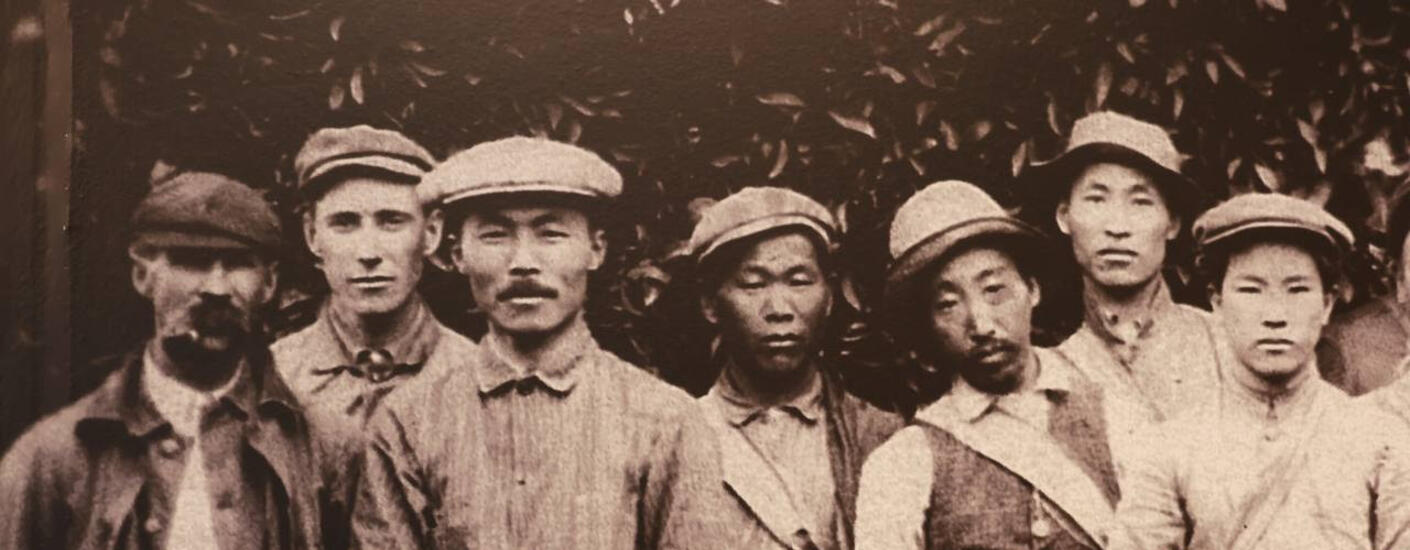
Image Credit:
Archive photo courtesy of Korean Heritage Library, USC / Photo © 2021 Hyungwon Kang
Newhouse Fellows Series: Yoon Sun Yang
A Poor Yet Glamorous “Oriental” Man: Korean-Language Transpacific Gangster Fiction
3/8/2023 5–6:30 PM
Newhouse Center Lounge
Free and open to the public
This presentation aims to offer a new way of studying literature across national borders while calling attention to Korean-language literary texts written by ethnic Korean working-class migrants in the United States during the interwar period (1918‒1939). Postwar South Korean scholars have viewed them at best as secondary to national literature “proper,” the canon of which was compiled based on a fragile assumption about a homogeneous ethnonational reading community. By contrast, my reading suggests that these works, complex and groundbreaking, shed new light on the history of cultural imperialism. They were informed by the authors’ experiences as disenfranchised immigrants to the United States during a time when their civil rights at home were systematically infringed under Japanese colonial rule. I contend, on the one hand, that the writers’ transpacific and inter-imperial migrations enabled them to imagine what was not readily available to those whose writings were institutionally bound by colonial censorship law. On the other hand, writing in their native language instead of English allowed the authors to pronounce what would have been filtered out to meet the tastes of the mainstream American reading public. I propose to call these writers the creators of transpacific palimpsests, highlighting the ways in which they innovatively blended aesthetic practices from both sides of the Pacific to make sense of the world in which they had newly settled while boldly revising or even erasing the cultural and political legacies no longer relevant to them. To make a case for my approach, I will analyze Nak Chung Thun’s Korean-language gangster fiction “The Righteous Robber” (undated, circa 1933‒37), which presents a working-class Asian male figure new to not only North American but also Korean cultural imaginations in the 1920s and 30s.
This event is free and open to the public. No prior registration is required for Wellesley College students, staff, and faculty.
This event will be livestreamed over Zoom. To register for Zoom attendance, click here.
For more information, please contact:
lcote2@wellesley.edu