The Davis Museum is temporarily closed for the summer. Operating hours resume on Friday, September 25, 2026.
The Manicure
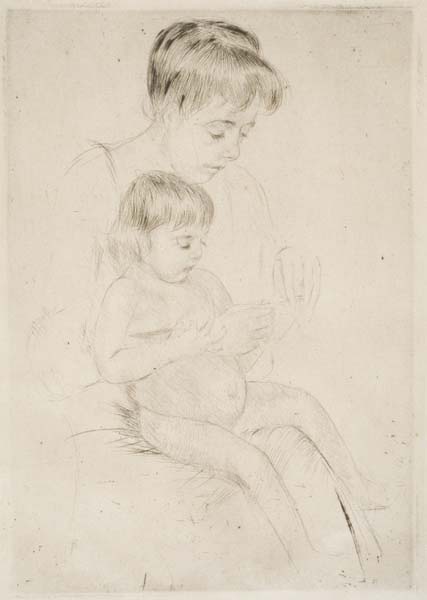
Mary Cassatt
The Manicure
Mary Cassatt (American) (b. 1844, Allegheny, Pennsylvania- d. 1926, Chateau de Beaufresne, near Paris, France)
The Manicure, 1908
Etching and Drypoint, sheet: 12 9/16 in. x 9 1/4 in. (31.9 cm x 23.5 cm)
Bequest of Mrs. Toivo Laminan (Margaret Chamberlin, Class of 1929)
1979.25
Born in Allegheny, Pennsylvania in 1844, Mary Cassatt spent the majority of her life in France, becoming the only American artist to join the French Impressionist movement. She officially settled in Paris in 1874, just as the artistic innovations of Impressionism were being developed. Impressionist artists were known for rejecting the realist styles promoted by the Academie des Beaux-Arts, the institution that selected works for exhibitions at the Paris Salon. Rather than focusing on the details of a scene, Impressionists tried to capture the essence of a subject by using thick strokes of paint and wide-ranging color palettes, and by emphasizing natural light in their paintings. Though Cassatt began her career copying Old Master pictures in agreement with the academy’s precepts, Edgar Degas invited her to exhibit with the Impressionists in 1879. She would go on to take part in four of their five independent exhibitions between 1879 and 1886.
Though categorized as an Impressionist, the subjects of Cassatt’s paintings often vary from those of her peers. While artists like Monet, Pissarro, and Seurat were painting landscapes, Cassatt focused on relationships, and hoped to capture the personal and subtle interactions shared between her sitters. Many of her best-known works highlight the roles of motherhood, and feature domestic scenes with women and children.
In The Manicure, an adult female figure sits with a young girl or boy in her lap. With her left hand, she uses a pair of scissors to clip the child’s fingernails, while her right arm hugs the child closer, emphasizing a sense of tenderness and protection. The outline of the woman’s body is faint, a common feature in many of the artist’s sketches and paintings; Cassatt would often concentrate on just the head of the figure, leaving the surrounding areas lightly rendered.
Throughout her career, Cassatt gained great recognition for her prints. This work exemplifies the practice of drypoint etching, a popular printmaking technique among artists during the late-19th and early-20th century. In order to create the image, Cassatt would have drawn directly and irreversibly on a copper plate with a diamond or ruby-pointed stencil or stylus. This process gives the image the appearance of a pencil sketch.
Hannah Augst ’17
Davis Museum Summer Intern, 2015