The Davis Museum is temporarily closed for the summer. Operating hours resume on Friday, September 25, 2026.
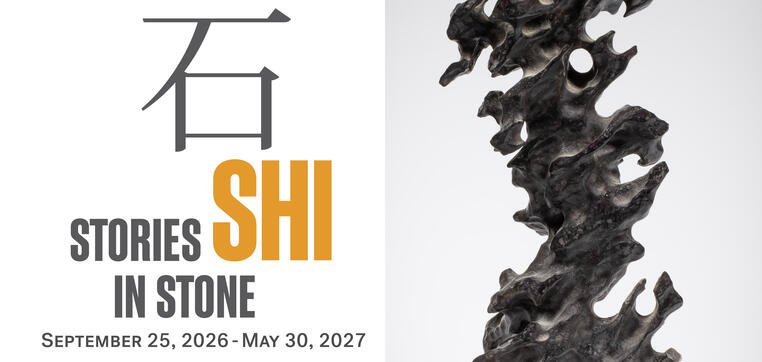
China, Ying Stone in the Form of Spiraling Incense Smoke, Modern period, 20th century, Limestone from Yingde county, Guangdong province, 20th-century wooden stand, Southern openwork style, Gift of Alan Helms 2024.15.7a-b
The shape of 石 shi, the Chinese character meaning "stone" or "rock," mimics a small stone falling from a high cliff. The word “shi” can be associated with three categories of material: rocks, minerals, and fossils. For at least one thousand years, the Chinese have collected and studied shi. They assort shi by place of origin, composition, texture, and function. They make unique display stands to appreciate shi and place them in gardens or on desks. They seek out qishi (strange stones) and guaishi (odd stones) for their unusual forms. They call their prized stones gongshi (offering stones) to show their reverence. In English, these stones are commonly called scholar’s rocks. This name indicated that historically, an educated elite led the collection of shi. Today, people from around the world collect stones, and new types of shi are collected and appreciated, showing the tradition is vital and evolving. Shi: Stories in Stone invites cross-disciplinary perspectives on nature, science, art, and culture. The Davis Museum's encyclopedic stone collection was a generous gift from Alan Helms, Professor Emeritus of English at the University of Massachusetts Boston and the University of Paris.
Shi: Stories in Stone was curated by Yuhua Ding, Kemper Assistant Curator of Collections and Academic Affairs. Loans from the Herbert F. Johnson Museum of Art and the Harvard Art Museums were vital for the exhibition’s success. Special thanks for the generous support from Kate and Gerald Chertavian, Chen Kezhan, Mathieu O. Gaulin, Marilyn Hamburger, Mee-Seen Long ‘72, Kemin Hu, Praise Shadows Art Gallery, Sophie Sa ‘65, Yvonne L.C. Wong, Yu-Wen Wu, and Xutizhai Collection. This exhibition was funded in part with a donation from Morgan Stanley, with support from Eric Hamburger. Shi: Stories in Stone was realized with major funding from the Alice Gertrude Spink Art Fund, Sandra Cohen Bakalar ‘55 Fund, Davis Museum Endowed Fund for International Cultural Programming, and the Davis Museum Asian Studies Advancement Gift.