The Davis Museum is temporarily closed for the summer. Operating hours resume on Friday, September 25, 2026.
Wakamatsuya uchi Midorigi (Midorigi of the Wakamatsuya)
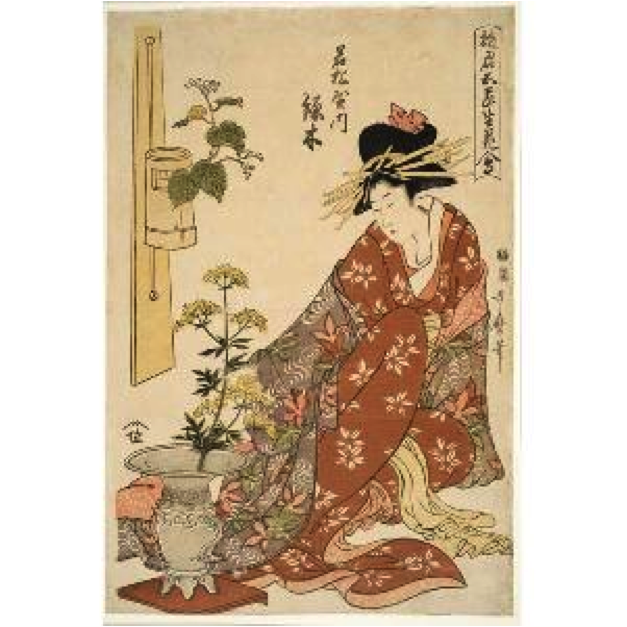
Kitagawa Utamaro
Wakamatsuya uchi Midorigi (Midorigi of the Wakamatsuya)
Kitagawa Utamaro(b. 1753, Kawagoe, Japan – d. 1806, Tokyo, Japan) Wakamatsuya uchi Midorigi (Midorigi of the Wakamatsuya), from the series "Yukun Gosetsu Ikebana-e" (A Collection of Courtesans Arranging Flowers during the Five Festivals), ca. 1805. Color woodblock print, 15 3/8 in. x 10 3/8 in. Gift of Mr. and Mrs. Joseph M. Edinburg (Dorothy Braude, Class of 1942) 1970.43
Kitagawa Utamaro was a master Japanese printmaker and painter whose graceful depictions of women established him as one of the most important artists of the ukiyo-e (“pictures of the floating world”) school of Japanese wood-block printing. Like other artists who belonged to this movement, Utamaro took everyday scenes as his subjects, elevating them from the ordinary to sophisticated and fashionable representations of daily life. In this print, from the series A Collection of Courtesans Arranging Flowers during the Five Festivals, the artist shows a courtesan purportedly engaged in the simple task of tending to flowers. However, her ineffectual performance of this task illustrates her decorative function in the print as an element of an artfully arranged composition; the flowers themselves are secondary to those that pattern her extravagantly draped robe. Executed in lush, billowing curves, the robe is suggestive of the softness of the form beneath and provides a contrast to the structured vase in the foreground. Throughout the print, Utamaro constructs the viewer’s experience: our gaze follows the courtesan’s outstretched arm to the rigid flower stem, which points toward the vertical wall element. Thus, the artist unites each component of the composition in a harmonious scheme that communicates a sense of refined elegance.
Though Utamaro studied under the ukiyo-e artist and scholar Toriyama Sekiem, he was primarily influenced by the work of Torii Kiyonaga, the prominent ukiyo-e artist of his youth. Kiyonaga’s prints of elegant figures in urban settings no doubt informed the artist’s later prints, as did his idealized women with willowy proportions. This figural trend was prevalent in the work of many later artists, but the specific look of Utamaro’s women is most well known. Tall and slender with long oval faces, elongated eyes, and delicate mouths, they simultaneously celebrate the beauty of Japanese women while representing a homogeneous ideal. The courtesan depicted here, for instance, could easily be any of the other women in the A Collection of Courtesans series.
Utamaro’s refusal to differentiate these women with individual features likely reflected an aesthetic choice as well as an effort to abide by censorship laws that forbade printmakers from identifying women other than courtesans by name. In 1804, Utamaro published the triptych Taikō Hideyoshi and his Five Wives on an Excursion, depicting the military ruler along with his wife and concubines in what was felt to be an insulting manner. As punishment, he was jailed for three days and spent fifty days under house arrest in handcuffs. The humiliation suffered by the artist ended his career and likely impacted his health; he died the following year. Despite the brevity of his artistic production, Utamaro is considered by many contemporary critics to be the greatest Japanese printmaker. Along with artists such as Katsushika Hokusai and Utagawa Hiroshige, he was also one of a few Japanese artists to exert a strong influence upon the direction of Western art in the 19th and even the 20th century.
Emily Zhao ‘17
Davis Museum Summer Curatorial Intern, 2015