Free and open to all from Tuesday to Sunday 11 AM to 5 PM. The Davis is closed on Mondays and holidays.
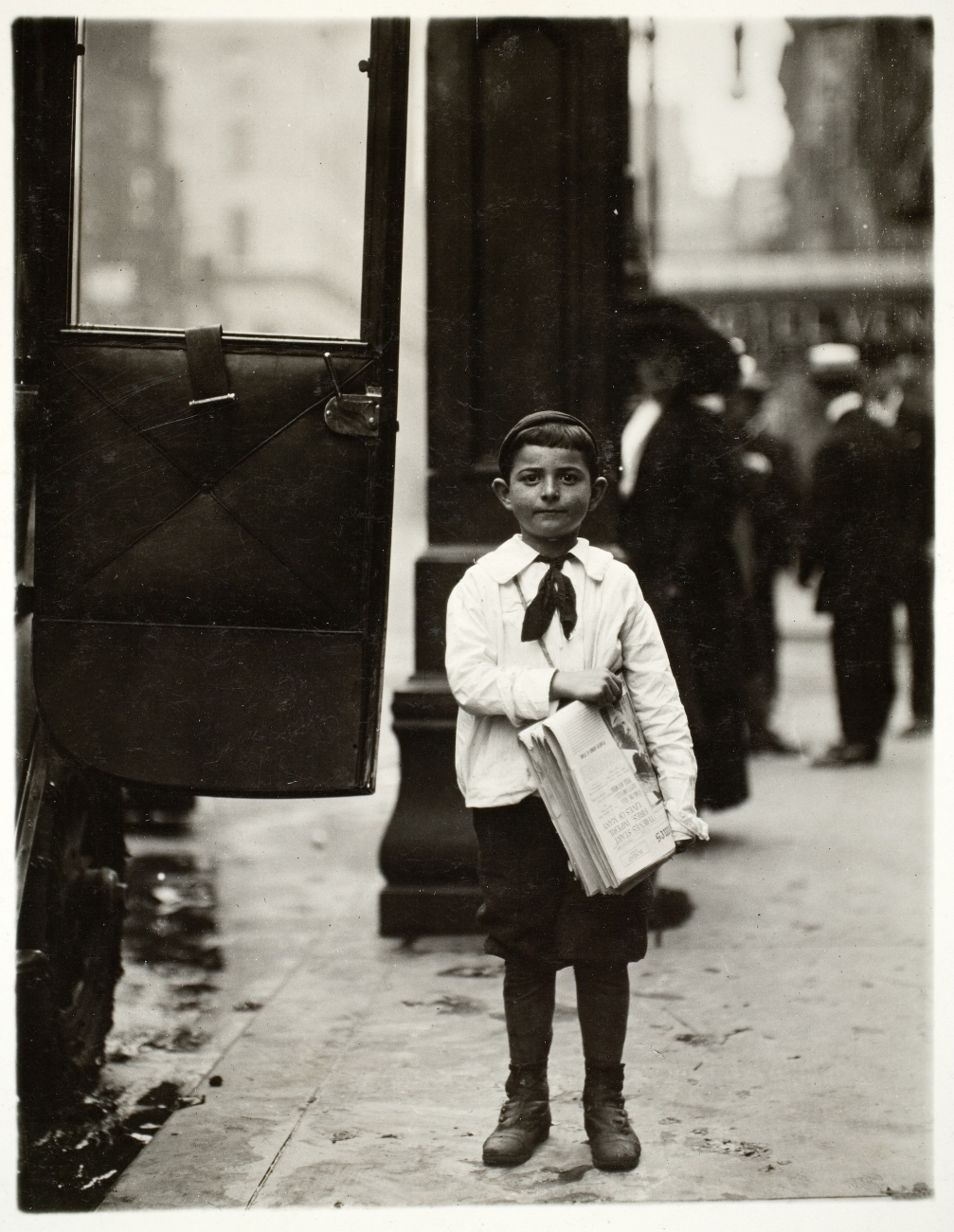
Dominick Carroll, Newsboy, Philadelphia, Pennsylvania
Lewis Wickes Hine
Dominick Carroll, Newsboy, Philadelphia, Pennsylvania,
Lewis Wickes Hine, Dominick Carroll, Newsboy, Philadelphia, Pennsylvania, June 1910. Gelatin silver print, image: 5 in. x 7 in. (12.7 cm x 17.8 cm); sheet: 5 in. x 7 in. (12.7 cm x 17.8 cm). Museum purchase with funds provided by Wellesley College Friends of Art. 1970.22
Lewis Wickes Hine’s (1874–1940) extended title for this early twentieth century photograph reads, “Dominick Carroll, 8 years old (appears 6). Newsboy. Sells from 3PM to 7PM. Income 25 cents per day. This boy sells papers for his brother who is 12 years old. Does not gamble, drink or smoke.” Hine, an American sociologist and photographer of Wisconsin origin, was one of the earliest photographers along with Dorothea Lange and Walker Evans to use the camera as a documentary tool for social reform. Even before becoming photographer for the National Child Labor Committee in 1908, when Hine worked as a schoolteacher in New York he taught his students to use photography as an educational medium. Hine was instrumental in changing child labor laws in the early 1900s, and this striking photograph of a young Philadelphia “newsie” represents exactly the kind of message that Hine hoped to convey to his audience: urban hardship and the face of lost youth.
Like Dominick, many of Hine’s photographs of children are blunt and stripped down. Here, the subject’s placement, close to the picture plane, serves to stress the raw emotion in his eyes and jaw. Despite their young age, Hine’s subjects candidly project mature expressions of determination, fear, wariness, sadness, or resignation that are typically only found on the faces of adults. As the extended title of this photograph suggests, Hine often interviewed his subjects in order to include a few details of their lives in the titles. Hine photographed a variety of both rural and urban subjects but his photographs of cities’ young newsies were of particular interest to him. While Dominick’s life sounds tough, Hine’s other subjects would work past midnight or in rainstorms, would fall asleep in the streets after long shifts, and dangerously jumped on and off moving trolleys in the city. One boy even showed him the marks on his arm where his father had bitten him for not selling more papers.
Hine carefully framed his portrait of Dominick Carroll to evoke empathy in viewers. The boy’s determined brows, wary eyes, and strong footing make him appear older than his years, but he still has the round cheeks of boyhood and his newspapers are nearly as big as he is. He stands next to an open car door that subtly suggests both his height and the contrast between his state and that of those wealthy enough to own a car. His clean white jacket stands out starkly against the dark, grimy urban streets which emphasizes his innocence, youth, and the idea that urban life hasn’t hardened him yet. It suggests that social reform still has the power to change the lives of a new generation.
Kelsey Phinney ‘16
Davis Museum Summer Intern 2014