The Davis Museum is closed for Wellesley College’s winter break. Please join us at our spring opening celebration on February 5, 2026, at 4 pm.
Untitled
Oscar Bluemner
Untitled
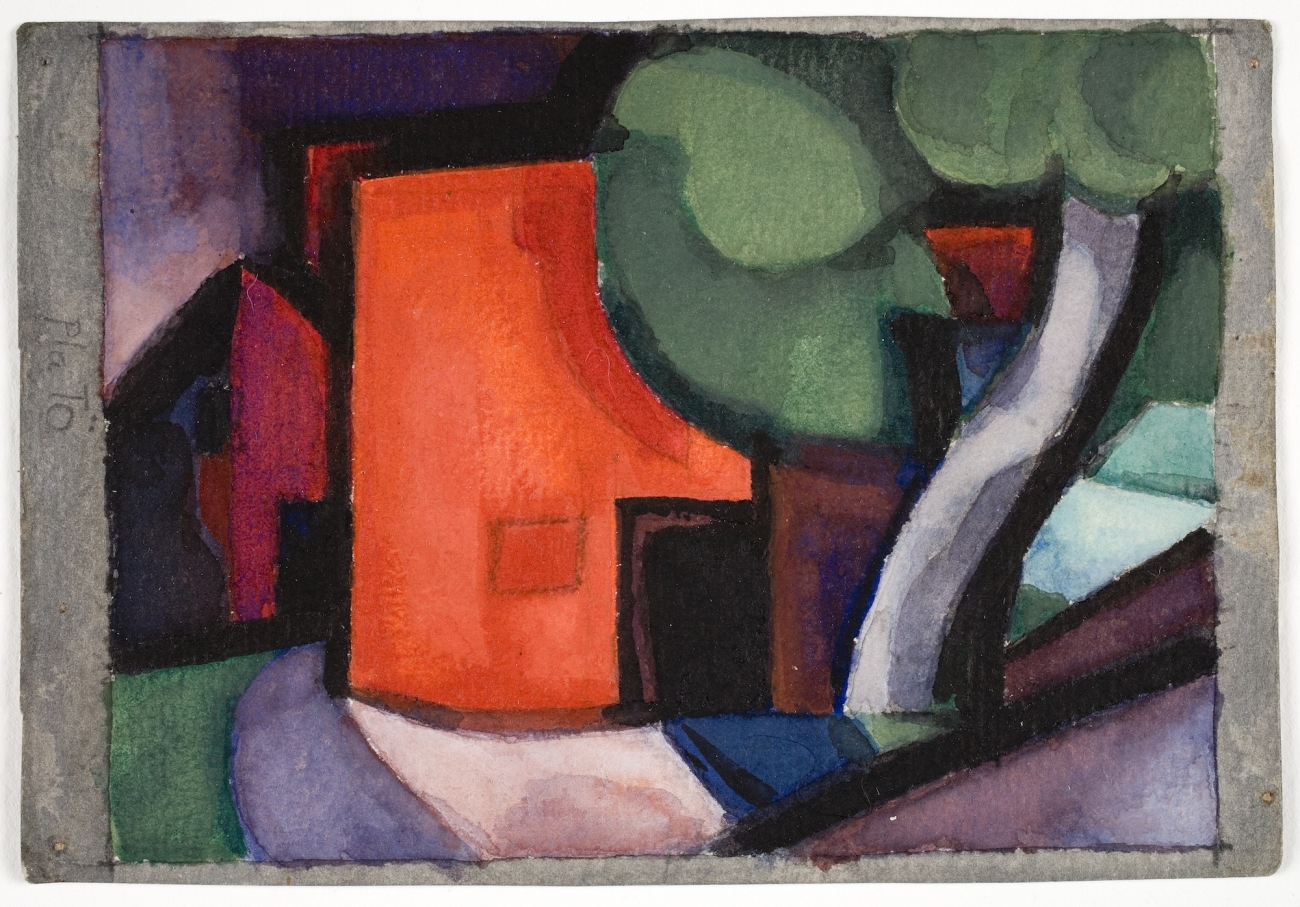
Oscar Bluemner, Untitled, 1930.
Watercolor, sheet: 4 in. x 5 13/16 in. (10.2 cm x 14.8 cm).
Museum purchase with funds provided by Wellesley College Friends of Art and
The Dorothy Johnston Towne (Class of 1923) Fund. 2005.22
An artist who fought crippling poverty at various points in his life, Oscar Bluemner sometimes found himself without the means to even buy canvas on which to paint. During these times, the artist wrote furiously, crafting and recording the philosophical principles that underpin his art, a task he found to be of immense importance. These writings offer great insights into the work of the artist, whose landscapes of dramatic forms and saturated color are not easily defined by any single artistic movement.
Bluemner, a German-born architect and painter, moved to the United States in 1892 and under the direction and patronage of Alfred Stieglitz abandoned commercial architecture to focus solely on his painting in 1910. As we learn from his writing, Bluemner believed in the extraordinary power of the familiar landscape. He wrote, “I prefer the intimate landscape of our common surroundings [for] we carry into them our feelings of pain, and pleasure, and moods…I am able to let the simple objects of a scene, a house, a tree, a sky or water be my actors.” Though his work is quite abstracted at times, he never entirely betrays these familiar visions. Rather than create an abstract painting representing his pure feeling at viewing a landscape, Bluemner instead represents the landscape as he saw it but formed in such a way, through the use of line and color, as to impart to the viewer the exact sensation that inspired the work. In this way, the viewer is able to recreate what the artist felt, a process that Bluemner believed abstract artists often kept from viewers.
Bluemner’s primary tools in this enterprise are line and color; he also found inspiration in Asian and Symbolist art. Color was of extreme importance to the artist and his writings betray his intense fascination with the psychological and spiritual effects of color, especially as laid down in the German writer Goethe’s theories. Intent on creating deeply saturated colors in the 1920s, Bluemner invented a special three-fold process of watercolor involving solid gouache underpaint, full glazes with casein, and formaldehyde sizing. This allowed for the powerful colors that enliven this landscape and other works in his oeuvre. Bluemner would begin with color, which represented on the most basic level his inner consciousness and experience, and then move to form, to capture the outward experience of this consciousness. Bluemner’s landscapes can be taken as a form of semi-self-portraiture, a site where the physical, emotional, intellectual, and spiritual aspects of being find both conflict and resolution in his distinctly powerful use of color and line.
Sophie Kerwin ‘16
Summer Curatorial Intern 2014