Free and open to all from Tuesday to Sunday 11 AM to 5 PM. The Davis is closed on Mondays and holidays.
Sandwich and Soda
Roy Lichtenstein
Sandwich and Soda
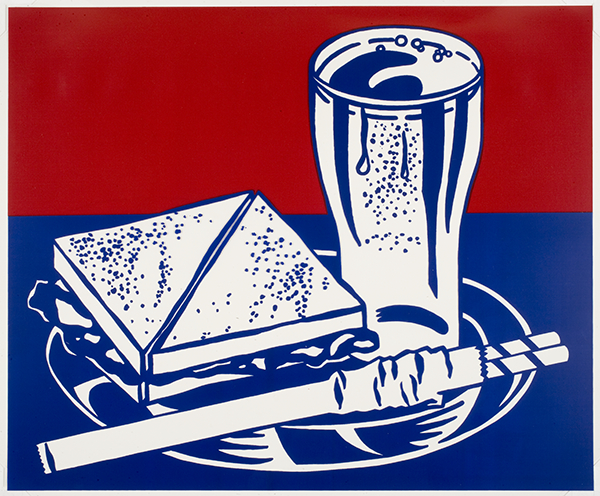
Roy Lichtenstein, Sandwich and Soda, from the portfolio Ten Works by Ten Painters. Copyright 1964. Screen print on clear plastic, sheet: 24 in. x 20 in. (61 cm x 50.8 cm). Gift of Milly and Arne Glimcher (Mildred L. Cooper, Class of 1961) 2003.68.5
Although this untitled screen print seems the epitome of mid-twentieth century Americana—a diner sandwich and soda for two to share executed in a patriotic color scheme with the squeaky clean lines of popular advertising—Roy Lichtenstein (1923–1997) saw his work as more industrial than American. Drawing inspiration from comic strips and ads, his hard-edged, precise compositions came under intense criticism for their perceived unoriginality and machine-like production. Lichtenstein responded to his critics by arguing that he approached the reproduction of prints through the lens of the mass media. He often copied comic book panels and advertisements directly, making stylistic changes in scale, color, and treatment to exaggerate certain ideas about art and society.
Lichtenstein remains one of the most iconic American pop artists among the ranks of Andy Warhol and Jasper Johns. He was an extremely important and influential leader in this art movement due to his incorporation of sly, tongue-in-cheek humor into this radical new conception of art. Lichtenstein spent the majority of his life in Manhattan, the epicenter of the glaring consumerism of postwar America, and the influence of the slick advertisements that surrounded him clearly manifest in his art. Some comic book artists scorned Lichtenstein for seemingly mocking their work, but Lichtenstein argued that he was simply highlighting aspects of American consumerism without personal bias or judgment.
Sandwich and Soda, from the portfolio Ten Works by Ten Painters, which also features works from modern greats such as Stuart Davis and Frank Stella, serves as a portrait of mid-century American culture. The commonplace American fare depicted was a frequent subject of early 1960s pop art. The sanitized feel of the sharp lines and flat fields of red and blue on a glossy, clear acetate evokes the new idealized nature of print advertisements while still maintaining the wistful, familiar imagery of the 1960s diner date.
Kelsey Phinney ‘16
Davis Museum Summer Intern 2014