The Davis Museum is temporarily closed for the summer. Operating hours resume on Friday, September 25, 2026.
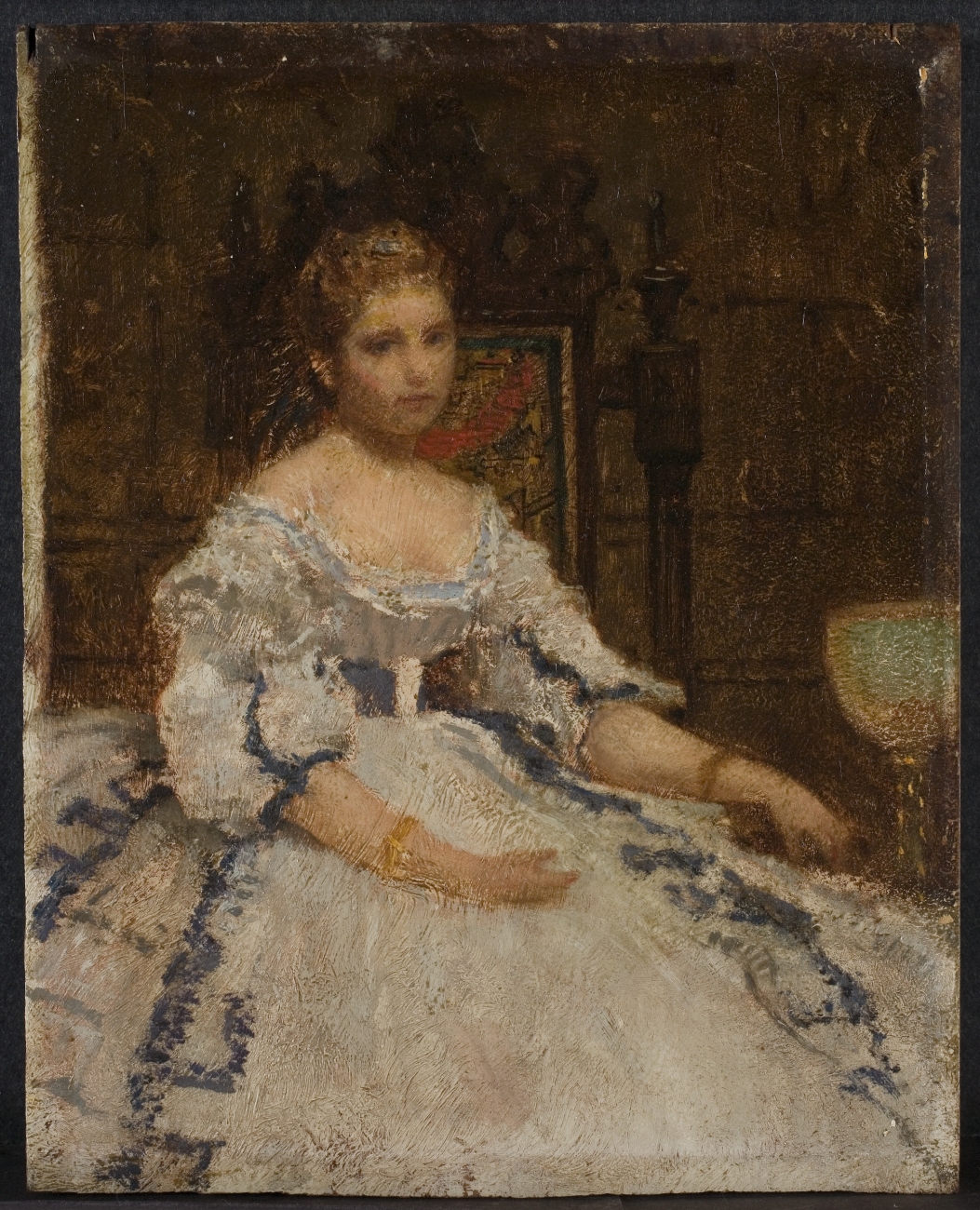
Sketch for Portrait of Mary Crowninshield Warren Hammond
William Morris Hunt
Sketch for Portrait of Mary Crowninshield Warren Hammond
William Morris Hunt (b. 1824, Brattleboro, Vermont-d. 1879, Isles of Shoals, New Hampshire) Sketch for Portrait of Mary Crowninshield Warren Hammond, 1865. Oil on panel, 9 3/8 in. x 7 1/2 in. Gift of Samuel Hammond VI in memory of Leila Hammond Duncan (Class of1951), daughter of Isabel Alleyn Hammond (Class of 1925) and sister of Mary Hammond Norton (Class of 1954) 1980.99
William Morris Hunt was born in Brattleboro, Vermont on March 31, 1824 to one of the most prominent families of that state. His father John served as a United States Representative from 1827 until his untimely death in 1832. Two of his four siblings also rose to national prominence as artists — architect Richard Morris Hunt, who designed the facade of the Metropolitan Museum of Art, and Leavitt Hunt, who was one of the first photographers of the Middle East. Upon the death of the Hunt patriarch, Hunt’s mother moved her family to Europe where they stayed for twelve years. It was in Europe, particularly in France, where Hunt honed his skills as a painter and became a follower of the famed Barbizon School.
Based in the French village of the same name, the Barbizon School was a group of painters working in the mid-1800s who spearheaded the shift from Romanticism to Realism. These painters, including Theodore Rousseau, Jean-Baptiste-Camille Corot, and Jean-François Millet, explored the portrayal of the wooded landscape through softer, broader brushstrokes that contrasted with the traditional, neoclassical style of the École des Beaux-Arts. Millet, in particular, had a profound influence on Hunt who met the most famous of the Barbizon painters through fellow American William Babcock. After studying with renowned French painter and teacher Thomas Couture in Paris, Hunt felt compelled to emulate Millet’s Realist style and subject matter, namely peasants in the rural landscape. For two years, Hunt worked in Barbizon, producing works with the same themes and subjects as his mentor.
When Hunt returned to New England in 1855, he introduced a generation of artists and collectors to the Barbizon School, and in turn established himself as one of the preeminent American painters. In fact, his promotion of Millet led Boston to possess one of the largest collections of Barbizon works outside of Europe. Due to the demands of the traditional New England market, Hunt pursued commissions as a portrait painter for Boston’s elite, abandoning pastoral landscapes and workers. The Sketch for Portrait of Mary Crowinshield Warren Hammond is a highly detailed study for one of these portraits that follow in the aristocratic style and draw on his training from Couture. Mary Hammond, who was twenty-four at the time and had married Samuel Hammond IV—the grandfather of the donor—seven years prior, sits gracefully in a three-quarter profile view, the signs of her wealth, such as a richly painted chair and gold chalice, conspicuously displayed. After the completion of this portrait, Hunt switched from primarily painting idealized portraits of wealthy patrons to rendering friends and family with greater naturalism.1 However, this portrait still reveals the influence of the Barbizon School on Hunt through the earth tones of his palette and softness of his brushstroke.
Dominique Ledoux ‘14
The Eleanor P. DeLorme Intern, Summer 2014
1 Sally Webster, William Morris Hunt: 1824-1879 (Cambridge: Cambridge University Press, 1991), 73-74.