The Davis Museum is temporarily closed for the summer. Operating hours resume on Friday, September 25, 2026.
La Revue Blanche
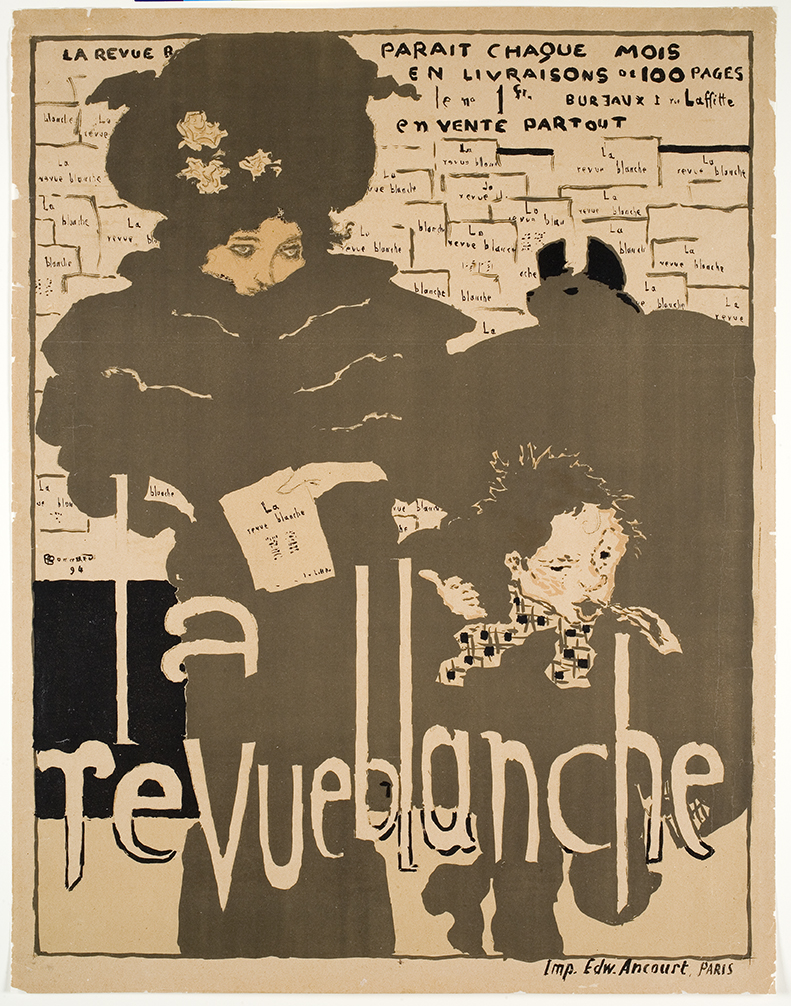
Pierre Bonnard
La Revue Blanche
Pierre Bonnard (French) (b. 1867, Fontenay-aux-Roses, France-d. 1947, Le Cannet, France) La Revue Blanche, 1894
Color lithograph, sheet: 31 1/2 in. x 24 7/16 in. (80 cm x 62.1 cm)
Bequest of Mrs. Toivo Laminan (Margaret Chamberlin, Class of 1929)
1979.21
Color lithograph, sheet: 31 1/2 in. x 24 7/16 in. (80 cm x 62.1 cm)
Bequest of Mrs. Toivo Laminan (Margaret Chamberlin, Class of 1929)
1979.21
In 1889, Pierre Bonnard joined the Post-Impressionist group of artists known as the Nabis (“prophet” in Hebrew). These artists, led by Maurice Denis and Édouard Vuillard produced prints and decorative screens, often inspired by Japanese woodblock prints, that blurred the distinction between the fine and graphic arts. Bonnard was known as the Nabi japonard due to the strong presence in his work of bold colors, clearly delineated forms, lack of perspective, and robust figures covered in sumptuous drapery often found in Japanese art, prints specifically. These influences are especially evident in his lithographs and illustrations for the Parisian literary magazine La Revue blanche.
Founded in Belgium in 1889 and then published in Paris two years later, La Revue blanche disseminated work by avant-garde writers, critics, and artists such as Marcel Proust and Guillaume Apollinaire. The magazine also served as a means for the intelligentsia to discuss social and political issues of the day, most notably the Dreyfus Affair. According to Symbolist writer André Gide, La Revue blanche was the “gathering spot open to every point of view.” Its financers were the Natanson brothers – Alexandre, Alfred, and Thadée – who befriended and patronized the Nabis. Bonnard, in particular, became close to Thadée and his wife Misia. In 1894, Thadée asked Bonnard to create the first print for the cover of the magazine, initiating Bonnard’s career as a poster designer and illustrator.
Bonnard’s lithographic poster for La Revue blanche features an elegantly cloaked woman holding a copy of the magazine in question, and an impish newsboy, both with reddish faces. In the background lurks a monstrous silhouette — that of top-hatted dandy. The words, “La Revue B[lanche] Parait Chaque Mois En Livraisons de 100 Pages en Vente Partout,” along with the magazine’s address at the rue Laffitte, appear above the figures’ heads. The irregular block letters of the magazine’s name grow from the mantle of the French woman who resembles her Japanese counterparts, and possibly Misia — a muse for many of the Nabis; Bonnard would use a similar version of this figure a few years later on his interior screen panels, such as Nannies Out for a Walk (1899). The flattened space, realized through the stark contrast between black and white, geometric patterns, and undulating lines coupled with scrawl-like graphic words, evoke Japanese woodblock prints, thus lending to the poster an avant-garde quality despite its commercial function. With this poster, Bonnard set the standard not only for the cover of the next issue to be designed by Henri de Toulouse-Lautrec, but also ushered in the age of commissioning cutting-edge fine artists to create eye-catching and novel advertisements.
Dominique Ledoux ‘14
Eleanor DeLorme Intern, Summer 2014