The Davis Museum is closed for Wellesley College’s winter break. Please join us at our spring opening celebration on February 5, 2026, at 4 pm.
Georges Braque
Georges Braque
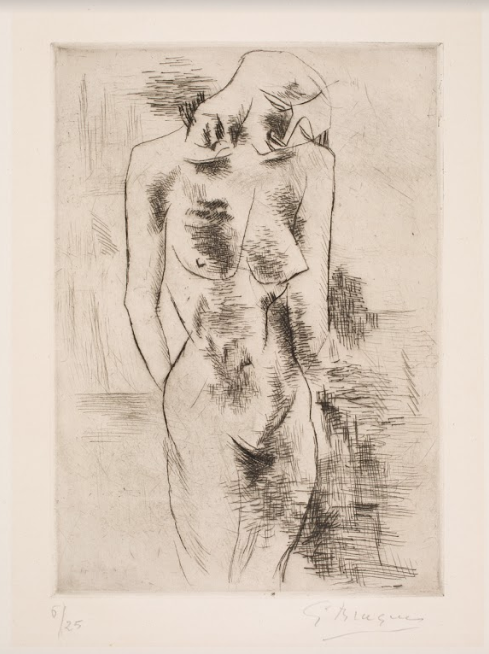
Etude de Nu (Study of a Nude)
Georges Braque, Argenteuil-sur-Seine, France 1882–1963 Paris, France, Etude de Nu (Study of a Nude), 1908, Etching, Gift of Mrs. Toivo Laminan (Margaret Chamberlin, Class of 1929) 1963.56
Born to a family of house painters in 1882, Georges Braque decided to focus on art classes instead of the family business. By 1904, he had rented a studio and begun to work on his own. His association with Pablo Picasso helped foster the birth and development of Cubism, and Etude de Nu shows Braque’s first forays into the movement. In Etude de Nu, Braque begins to abandon single-point perspective: lines in the stomach suggest two possible perspectives, and one breast is depicted in profile while the other is oriented frontally. The tilting form and similarly-textured lines blur the relationship between figure and background.
Etude de Nu was the first print Braque created. An edition of 25, this work illustrates Braque’s etching method. Varying line quality is evident in the etching, from the fine lines in the figure’s left thigh, to the thicker lines that Braque carved more deeply into the etching plate. Variations in darkness suggest Braque placed the plate in an acid bath for a second time, covering areas he wanted to remain lighter with an acid-resistant ground. Although Braque created most of the etching with one sharply-pointed tool, he switched to a double-pointed tool to create texture for some of the background areas. This work is one of a small number of Cubist etchings Braque created between 1908 and 1912, preceding his time as one of the first School of Paris artists to focus on printmaking in the aftermath of World War II.
-Veronica Mora, Class of 2018
Gift of Mrs. Toivo Laminan (Margaret Chamberlin, Class of 1929) 1963.56