Free and open to all. Tuesday to Sunday 11 AM to 5 PM, closed on Mondays and holidays.

In Focus highlights the creative range of practices among the professional artists on the Wellesley College faculty. This exhibition features works across various media, including photography, painting, collage, sculpture, book arts, printmaking, installation, video, sound, and interdisciplinary art forms. The artists featured are Kathryn Abarbanel, Genevieve Cohn, Claudia Joskowicz, Kathya Landeros, Phyllis McGibbon, Andrew Mowbray, Daniela Rivera, Katherine Ruffin, and David Teng Olsen. As part of Wellesley’s anniversary celebrations, In Focus honors 150 years of faculty excellence at the College.
In Focus is curated by Dr. Nicole Berlin, Associate Curator of Collections, with Mark Beeman, Manager of Exhibitions and Collections Preparation, and includes contributions from Helen Connor, Assistant Registrar for Exhibitions and Digital Resources, and Nell Gould, Assistant Preparator. This exhibition is generously supported by the Mellon Academic Programs Fund, the June Feinberg Stayman ‘48 Art Fund, and the Wellesley College Friends of Art at the Davis.
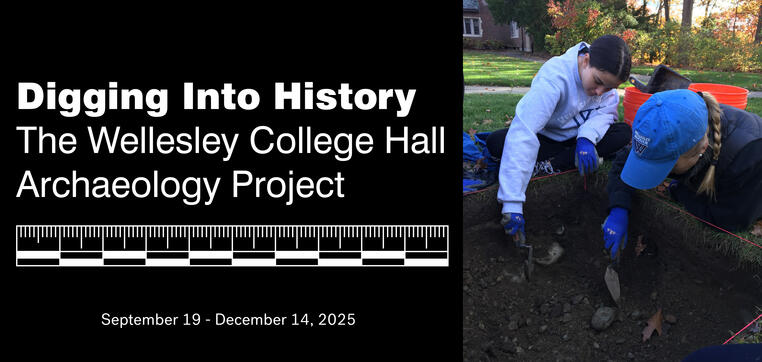
Alejandra Chaisson ’19 and Olivia Reckley ’18 excavate a unit near the staircase in Tower Courtyard. Photo courtesy of WCHAP.
Digging Into History: The Wellesley College Hall Archaeology Project (WCHAP) explores the rich legacy of College Hall—the iconic building that once stood at the heart of Wellesley College—through a community-based excavation led by former Wellesley faculty member Dr. Elizabeth Minor ’03. Destroyed by fire in 1914, College Hall housed nearly every function of the College: dormitories, classrooms, laboratories, and cultural collections. Its loss was deeply felt, but its remains provided a powerful opportunity for rediscovery.
From 2017 to 2023, over 100 students and volunteers unearthed fragments of daily life—charred books, ceramics, architectural elements—that offered tangible connections to the lived experiences of early Wellesley students. These findings shed light on how College Hall fostered an immersive and interdisciplinary environment at the dawn of women's higher education.
WCHAP demonstrated the power of community-driven, participatory research, and experiential learning. It made archaeology accessible in Wellesley’s own backyard and addressed inequities in the field by centering local knowledge and inclusion. Digging Into History invites reflection on how the past informs our present—just as Wellesley marks its 150th anniversary by honoring an extraordinary history, looking toward an exciting future, and reaffirming its commitment to educating women who will make a difference in the world.
Digging Into History is co-curated by Dr. Nicole Berlin, Associate Curator of Collections, and Dr. Elizabeth Minor ’03, former Wellesley College Anthropology faculty member and current Assistant Professor at California State Polytechnic University, with contributions from Alejandra Chaisson ’19, Anjali Aralikar ’23, Anna Calderon ’23, Rebecca Darling, Assistant Director of Instructional Technology, Georgia Oppenheim ’20, Julz Vargas ’24, Juening Mao ’26, Kalei Oliver ’20, Kelly Giudice DS ’25, Mary Beth Timm, Interim Co-Director and Associate Director for Operations and Collections Management, McKenna Morris ’19, Megan Rodriguez-Hawkins ’25, Paola Favela ’19, and Rachel Tao ’19.
Thank you to additional WCHAP participants and supporters: Abby Jarcho ’26, Alex Cahn ’23, Allie Beighle ’26, Anastacia Markoe DS ’23, Anna Smith ’23, Ashley Bisram ’22, Ash He ’24, Audrey Ballarin ’23, Aylish Klepper ’21, Blythe Terry ’23, Caden Rijal ’23, Caylee Pallato ’20, Clara Ferrari ’20, Coco Plasencia ’24, Deyra Aguilar ’24, Eliene Wu ’20, Em Kramer ’23, Emma Ross ’24, Giulia Bronzi ’21, Ginnie Peery ’24, Jen Enriquez ’24, Josephine Kim ’20, Josie Kutcha ’23, Kadidia Keita ’24, Kate Hall ’22, Karen Mueller ’23, Kasey Cole ’25, Katharine Gavitt ’21, Kelly Navickas ’19, Kyra Deehr-Lewis ’23, Lara Kurtz ’26, Looghermine Claude ’20, Lulu Al Saud ’20, Mads Jackson ’24, Madeleine Bettencourt ’22, Madison Miller ’21, Marie Delahousse ’26, Maddie Moon ’23, Olivia Arthur ’23, Oladunni Oladipo ’22, Patricia Tao ’23, Rachel Beaton ’21, Sabina Unni ’19, Sarah Guise ’20, Sissi Chen ’26, Sophia DeCubellis ’23, Sophia Greenberg ’21, Sophie Wilson ’22, Sreyneang Loeurng ’24, and many more…
The WCHAP excavation was supported through generous funding from the Paulson Ecology of Place Initiative. This exhibition is generously supported by the E. Franklin Robbins Art Museum Fund and the Mellon Academic Programs Fund.

Portrait of Suzanne Ciani ‘68, Undated. Courtesy of Suzanne Ciani.
Step into an original sonic experience in Suzanne Ciani: Sound Lounge. Sit down, slow down, and immerse yourself in the distinct soundscapes of three landmark albums by Wellesley alumna Suzanne Ciani ‘68. A five-time Grammy award-nominated composer, electronic music pioneer, and neo-classical recording artist, Ciani has released over twenty solo albums. Her work has also been featured in films, games, and countless commercials.
Ciani released her first record, Seven Waves, in 1982. Its dreamy evocation of ocean waves through the soundwaves that Ciani created on the Buchla synthesizer would gain great popularity and critical acclaim first in Japan, next in the United States, and finally worldwide. In 1986, the title track of Ciani’s next album, The Velocity of Love, became a radio phenomenon and helped to launch the first New Age radio stations. Its romantic songs invite contemplation–and connection. You will imagine still more stories of love and travel as you listen to her third album, Neverland, which was released in 1988.
Ciani was inducted into the first class of Keyboard Magazine's Hall of Fame alongside other synth luminaries, including Bob Moog, Don Buchla and Dave Smith. She received the Moog Innovation Award, the Independent Icon Award from the American Association of Independent Music, and most recently, the 2023 SEAMUS Award for electroacoustic music. Ciani provided the voice and designed sounds for Bally's groundbreaking Xenon pinball machine, created Coca-Cola’s iconic pop-and-pour sound, designed logos for Fortune 500 companies, and carved out a niche as one of the most creatively successful female composers in the world. A Life in Waves, a documentary about Ciani’s life and work, debuted at SXSW in 2017 and is available to watch on all digital platforms.
In addition to her Bachelor of Arts in Music from Wellesley College, Ciani holds a Master's in Music Composition from the University of California, Berkeley.
This solo exhibition highlights an exemplary alumna during Wellesley’s 150th anniversary, as we honor an extraordinary history, look forward to an exciting future, and celebrate the College’s enduring commitment to providing an excellent education to women who will make a difference in the world.
Organized by Dr. Amanda Gilvin, Interim Co-Director, Sonja Novak Koerner '51 Senior Curator of Collections, and Associate Director of Curatorial Affairs, this exhibition is generously supported by the Mellon Academic Programs Fund.
Suzanne Ciani: Sound Lounge is presented in collaboration with the Wellesley College Music Department Concert Series.
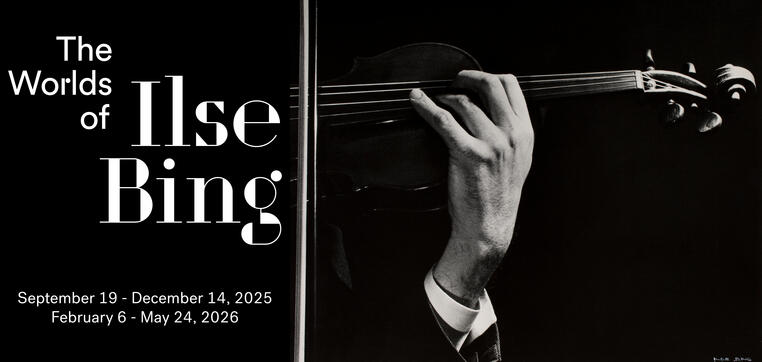
Ilse Bing, La Main de Szymon Goldberg, 1949, Gelatin silver print, 13 1/4 in. x 9 1/2 in., Gift of Suzanne Ciani (Class of 1968) 2018.266. © Estate of Ilse Bing.
Featuring a recent gift of vintage photographs by the groundbreaking photographer Ilse Bing (1899-1998), this exhibition explores the development of the photographic medium in the mid-twentieth century. The era in which Bing came to prominence saw the birth of the journalistic photo-essay, the launch of the 35-mm Leica camera, and experiments with abstract photograms and solarization. Artists led critical debates over how photography should remain true to itself as a medium of and for the modern world. From Frankfurt to Paris to New York City, Bing was at the center of it all, carving out a place for herself as “Queen of the Leica” in a male-dominated world of image making. The Worlds of Ilse Bing is organized geographically according to the three cities where Bing lived, placing her work in conversation with the artists who made up her creative worlds and providing insight into her influences, process, and undeniable impact on others as they pushed the boundaries of modern art.
Curated by Dr. Carrie Cushman, Director of the Bates College Museum of Art and former Linda Wyatt Gruber ‘66 Curatorial Fellow in Photography at the Davis Museum, this exhibition is supported with funds given through the generosity of Linda Wyatt Gruber (Class of 1966).

France (Nevers), Gadrooned Dish, ca. 1700, Faience, Bequest from the Collection of Sidney R. Knafel 2023.3.24
Press release available here.
Nevers in the World presents a selection of artworks from the generous bequest of Sidney R. Knafel, who spent decades assembling a world-renowned collection of French ceramics. These objects demonstrate how artistic innovation can flourish through cross-cultural exchange. During the seventeenth and eighteenth centuries, a group of artisans in Nevers, France created extraordinary ceramic vessels using the faience technique. Invented nearly a millennium earlier, faience describes a glaze for ceramics that includes tin. In eighth-century Iraq, craftspeople discovered that adding tin to ceramic glaze produced an opaque, white surface suitable for colorful decoration. As the method spread across Asia and Europe, Italians called it maiolica. In France, it became known as faience, after the Italian city of Faenza.
In 1565, French aristocrat Henriette of Cleves married Italian politician Louis of Gonzaga, Duke of Nevers. The couple brought artisans from Italian maiolica centers to Nevers, where they introduced a style of storytelling through images in addition to tin-glaze. By 1600, European demand for Chinese porcelain spurred workshops in Nevers to attempt imitations in faience. Nevers artisans quickly developed a distinctive style that reached its zenith in popularity under King of France Louis XIV (1638-1715), when it featured in his elaborate dinner parties at Versailles. Today, these objects continue to tell stories about the people who made and used them.
Curated by Nicole Berlin, Associate Curator of Collections with Alicia Bruce, Friends of Art Curatorial Project Manager and Researcher, and Yuhua Ding, Kemper Curator of Collections and Academic Affairs. This exhibition is supported by the Sandra Cohen Bakalar ‘55 Fund, the Judith Blough Wentz '57 Museum Programs Fund, and Wellesley College Friends of Art at the Davis.
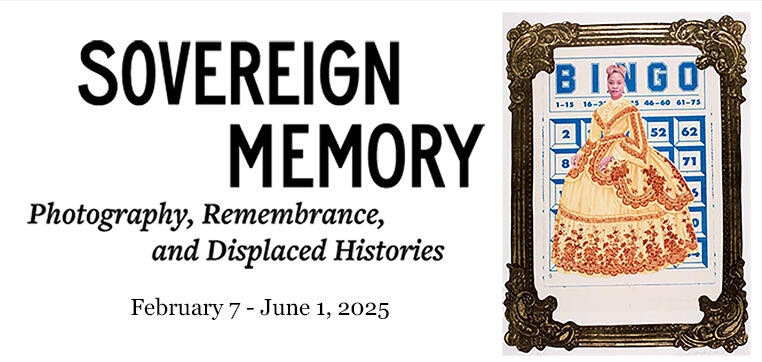
Mildred Howard, I've been a Witness to this Game XXII, 2016, Monoprint/digital with collage and gold leaf, Museum purchase, The Nancy Gray Sherrill, Class of 1954, Collection Acquisition Fund 2016.127, Courtesy of the artist
Press release available here.
Sovereign Memory: Photography, Remembrance, and Displaced Histories explores photography as a strategy for healing from what Gloria Anzaldúa, celebrated queer Chicana cultural theorist and poet, has described as the colonial wound. The artists in this group exhibition each employ the photograph as a connective tissue, stitching together individuals, families, and communities to severed histories and identities. All share a concern with how images profoundly shape the stories of where we come from–and who we are.
Photography has revolutionized how we represent our histories, solidifying architectures of personal and collective memory through archives born of visual technologies. Photography also has a darker history as a colonial machine producing images in support of empires. For communities who have endured the global longue durée of colonialism and continue to navigate legacies of its violence, histories told through the lens of photography can re-implement a colonial gaze, enacting a series of erasures. The multiplicity of personal and collective experiences becomes distilled into a single, simplified story told from an exterior perspective. Featuring a transnational selection of photographic works from the Davis’s collections, this exhibition expands that single, false story into many sovereign memories. These artworks have become emblems for reconnecting to known and unknown histories, enacting memory as an emancipatory strategy.
Curated by Jessica Orzulak, Associate Curator and Curatorial Affairs Manager at the Asheville Art Museum and former Linda Wyatt Gruber ‘66 Curatorial Fellow in Photography at the Davis Museum, this exhibition is supported with funds given through the generosity of Linda Wyatt Gruber (Class of 1966).
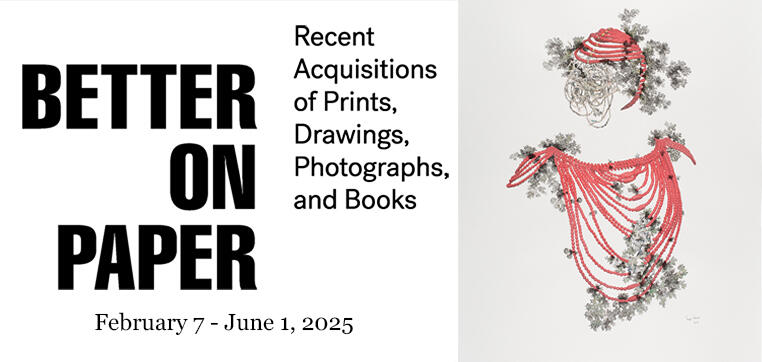
Taiye Idahor, Ekundayo, 2018, Photo paper collage, ink, and color pencil on paper, Museum purchase, Marjorie Schechter Bronfman '38 and Gerald Bronfman Endowment for Works on Paper 2019.948
Press release available here.
The Davis and the Wellesley College Library Special Collections join together to celebrate acquisitions of works on paper from the last decade that represent Wellesley’s commitment to inclusive excellence. Often collaborating with Wellesley faculty, staff, and students, curators have acquired the objects in Better on Paper to support and expand the Wellesley College curriculum. With books and works on paper that connect to every department on campus, Wellesley continues to enhance its renowned collections through purchases, gifts, and bequests. The prints, drawings, photographs, books, and other objects in Better on Paper originate from around the globe, spanning diverse makers and approaches, and dating to many periods. The Davis and Special Collections each host around 100 class visits annually.
The majority of the Davis’s collection consists of works on paper, including prints, drawings, collages, photographs, and more. In addition to displaying them in special exhibitions and the long-term galleries, Davis staff and Wellesley faculty frequently select artworks for class visits to the Print Study Room. Better on Paper includes just a fraction of the over 4,000 works on paper collected by the Davis between 2014 and 2024, highlighting many previously unseen artworks. This exhibition emphasizes contemporary art, while also showcasing many new acquisitions of art from past centuries.
Special Collections stewards rare books, manuscripts, contemporary limited editions, and non-traditional artists’ books. Through gifts and purchases over the last decade, over 2,000 acquisitions have been added. These include an instructive geography game for children, a satirical fan, and other objects of cultural history–in addition to many printed and manuscript books. Faculty, students, and independent scholars can request to view materials in Special Collections for individual research and class visits. In Better on Paper, curators highlight objects that support study in the humanities, social sciences, and natural sciences.
Building these collections supports today’s Wellesley Method: object-based and human-centered learning across the disciplines. We invite you to study, learn, and teach in this exhibition–and to find out more about the many other works on paper in the Davis Museum and Special Collections.
This exhibition was co-curated by Amanda Gilvin, Interim Co-Director, Sonja Novak Koerner '51 Senior Curator of Collections, and Associate Director of Curatorial Affairs, and Ruth R. Rogers, Curator of Special Collections and Visiting Lecturer, Art Department, with contributions from Nicole Berlin, Associate Curator of Collections, Alicia Bruce, Friends of Art Curatorial Project Manager and Researcher, Yuhua Ding, Kemper Assistant Curator of Collections and Academic Affairs, L. Goins ‘26, 2024 Summer Curatorial Intern, James Oles, Adjunct Curator of Latin American Art and Senior Lecturer, Art Department, Mariana S. Oller, Associate Curator of Special Collections, and Semente, Curator of Education and Public Programs.
Better on Paper is presented at the Davis with generous support from the Anonymous '70 Endowed Museum Program Fund, Marjorie Schechter Bronfman '38 and Gerald Bronfman Endowment for Works on Paper, and Wellesley College Friends of Art at the Davis.

Rory McEwen, Tulip 'Julia Farnese' rose feather, 1976, Watercolour on vellum, ©Estate of Rory McEwen
Rory McEwen: A New Perspective on Nature presents the vibrant career of the renowned Scottish artist, Rory McEwen (1932-1982). Focusing on his remarkable paintings of plants, the exhibition reveals McEwen’s lifelong enquiry into light and color in portraying his unique concept of the natural object. Over the course of his career, with his all-embracing perspective of modern art, McEwen developed a distinctive style, painting on vellum and using large empty backgrounds on which his plant portraits seem to float. In his paintings he forged his own personal interpretation of 20th century modernism, portraying individual flowers, leaves and vegetables as subject matter, “as a way of getting as close as possible to what I perceive as the truth, my truth of the time in which I live.”
Rory McEwen: A New Perspective on Nature presents 85 watercolors on vellum and paper, representing a wide range of the artist’s work, along with many of the well-known 17th and 18th century masters who influenced him—including Robert, Redouté, Ehret, Aubriet as well as early illuminated manuscripts and folio volumes. McEwen’s work is also presented alongside the works of numerous contemporary artists who in turn continue McEwen’s artistic legacy. It includes works on loan from the Collection of the Royal Botanic Gardens, Kew, Mellon’s Oak Spring Garden Foundation Collection, the Shirley Sherwood Collection and the McEwen Family Estate Collection, as well as works from numerous private collections, most of which have never before been seen by the American public. McEwen’s work is found in private and public collections across the globe, including the British Museum; Victoria and Albert Museum; Tate; National Gallery of Modern Art, Scotland; Fitzwilliam Museum, Cambridge; Hunt Institute, Pittsburgh; and Museum of Modern Art, New York.
The exhibition, Rory McEwen: A New Perspective on Nature, is presented by the Davis Museum at Wellesley College in association with Royal Botanic Gardens, Kew (London) and Oak Spring Garden Foundation (Virginia); tour management by Landau Traveling Exhibitions, Los Angeles, CA.
The Gerard B. Lambert Foundation has provided major support for the exhibition. Generous support for the Davis presentation is provided by Wellesley College Friends of Art at the Davis, the Alice G. Spink Art Fund, the Constance Rhind Robey '81 Fund for Museum Exhibitions, and the Kathryn Wasserman Davis '28 Fund for World Cultures.


RORY MCEWEN: A NEW PERSPECTIVE ON NATURE
Rory McEwen: A New Perspective on Nature presents the vibrant career of the renowned Scottish artist, Rory McEwen (1932-1982). Focusing on his remarkable paintings of plants, the exhibition reveals McEwen’s lifelong enquiry into light and color in portraying his unique concept of the natural object. Over the course of his career, with his all-embracing perspective of modern art, McEwen developed a distinctive style, painting on vellum and using large empty backgrounds on which his plant portraits seem to float. In his paintings he forged his own personal interpretation of 20th century modernism, portraying individual flowers, leaves and vegetables as subject matter, “as a way to get as close as possible to what I perceive as the truth, my truth of the time in which I live.”
Rory McEwen: A New Perspective on Nature presents 85 watercolors on vellum and paper, representing a wide range of the artist’s work, along with many of the well-known 17th and 18th century masters who influenced him—including Robert, Redouté, Ehret, Aubriet as well as early illuminated manuscripts and folio volumes. It includes works on loan from the Collection of the Royal Botanic Gardens, Kew, Mellon’s Oak Spring Garden Foundation Collection, the Shirley Sherwood Collection and the McEwen Family Estate Collection, as well as works from numerous private collections, most of which have never before seen by the American public. McEwen’s work is found in private and public collections across the globe, including the British Museum; Victoria and Albert Museum; Tate; National Gallery of Modern Art, Scotland; Fitzwilliam Museum, Cambridge; Hunt Institute, Pittsburgh; and Museum of Modern Art, New York.
The exhibition, Rory McEwen: A New Perspective on Nature, is presented by the Davis Museum at Wellesley College in association with Royal Botanic Gardens, Kew (London) and Oak Spring Garden Foundation (Virginia); tour management by Landau Traveling Exhibitions, Los Angeles, CA.
Generous support for this exhibition at the Davis is provided by Wellesley College Friends of Art at the Davis, the Alice G. Spink Art Fund, the Constance Rhind Robey '81 Fund for Museum Exhibitions, and the Kathryn Wasserman Davis '28 Fund for World Cultures.

Lorraine O’Grady (American, born 1934). Family Portrait 1 (Formal, Composed), 2020. Fujiflex print, 60 × 48 in. (152.4 × 121.9 cm). Edition of 10 plus 3 artist’s proofs. © Lorraine O’Grady/Artists Rights Society (ARS), New York
- Events
- Press Release
- Symposium: Teaching/Learning with Lorraine O'Grady's Both/And
- Taking the White Gloves Off: A Performance Art Series in Honor of Lorraine O'Grady ‘55
- Publication: Teaching/Learning with Lorraine O'Grady's Both/And
Lorraine O’Grady: Both/And is the first major career survey of the renowned conceptual artist and cultural critic whose work has challenged prevailing understandings around gender, race, and class for over four decades. The exhibition charts the development of O’Grady’s artistic oeuvre, which spans collage, photo-installation, performance, video, and text. It brings focus to the artist’s skillful subversion of the “either/or” logic inherent in the Western philosophical canon, and explores her longstanding commitment to the reasoning of “both/and.”
O’Grady’s work deals with a range of overlapping themes: Black female subjectivity in Western modernity and artistic modernism; colonialism and slavery; hybridity and diasporic experience; multiplicity and selfhood; and intersectional feminist theory and praxis. For O’Grady, the diptych form, by forcing sustained conversation, can hold tellingly chosen dissimilars still long enough to become familiar. In deploying the diptych as both artistic and conceptual strategy, O’Grady has achieved a transformational anti-hierarchical approach to difference. Over the course of her practice, she has refused the possibility of neat resolution and remained committed to keeping contradictions in play so as to undermine the power dynamics baked into the binary oppositions of self and other, male and female, West and non-West, Black and White, and past and present.
Lorraine O’Grady: Both/And is organized by Catherine Morris, Sackler Senior Curator, Elizabeth A. Sackler Center for Feminist Art, Brooklyn Museum, and writer Aruna D’Souza with Jenee-Daria Strand, Former Curatorial Associate, Elizabeth A. Sackler Center for Feminist Art, Brooklyn Museum.
Leadership support for this exhibition is provided by

Organized for the Davis Museum by Amanda Gilvin, Sonja Novak Koerner '51 Senior Curator of Collections and Assistant Director of Curatorial Affairs, the exhibition is presented at the Davis with generous support from the Mildred Cooper Glimcher '61 Endowed Fund, the Anonymous '70 Endowed Museum Program Fund, Wellesley College Friends of Art at the Davis, and the Alice G. Spink Art Fund.
Lorraine O’Grady would like to thank the following: Chappelle Freeman Jr., Edward Bowden Allen, Ellen Rosen, Richard DeGussi-Bogutski, Coreen Simpson, Salimah Ali, Eileen Harris Norton, Just Above Midtown (JAM), Linda Goode Bryant, Anne Fucci Criscitiello, Freda Leinwand, Gylbert Coker, Horace Brockington, Jennifer Manfredi, Ellen Sragow, Emily Velde, Bern 1905, Noah Jemisin, Lorenzo Pace, Beverly Trachtenberg, Bill O’Connor, Francine Berman, Steven Overman (Eastman Kodak Company), Marlon Ziello (Ziello Inc.), Corinne Jennings, Joe Overstreet, George Mingo, Keith Haring, New York State Council on the Arts, Whitfield Lovell, Robert Ransick, Lilith Dove, Nahna Kim, Shamus Clisset (Laumont Photographics ), Willie Vera (Laumont Photographics), the Marie Walsh Sharpe Foundation, the Davis Museum at Wellesley College, Shelley Fox Aarons and Philip E. Aarons, David Cabrera and Alexander Gray, the Radcliffe Institute for Advanced Study at Harvard University, Theo Davis, Courtney R. Baker, Irene Cheng, Adrienne Caldwell, Anonymous Was A Woman, Winslow Hinds, Carlo Montagnino, Tavis Delahunt (NB Technologies), Habby Osk, Carmen von Kende, Carolyn Tennant, Andil Gosine, Sur Rodney (Sur), Kyla McMillan, Ursula Davila-Villa, Brian Guerin, Kelly Spivey and Bill Seery (Mercer Media), Maria Elena Venuto (The Standby Program), Jason Crump (Metropolis Post), Art Matters, United States Artists, René Schmitt’s Druckgraphik, Stephanie Sparling Williams, Stacy A. Scibelli, Laura Lappi, Creative Capital, Jeff Wasson (Wasson Artistry), Matt White, John Umphlett, Miles Templeton, Scott Wilson (Darkwood Armory), Peter Johnsson (Albion Swords Ltd., LLC ), Mike Sigman (Albion Swords Ltd., LLC), Kerry Gaertner Gerbracht, Loretta Polk, Aruna D’Souza, Anne Pasternak (Brooklyn Museum), Catherine J. Morris (Brooklyn Museum), Audrey Walen (Brooklyn Museum), Page Benkowski (Alexander Gray Associates), Ken Wissoker (Duke University Press), Michael McCullough (Duke University Press), Laura Sell (Duke University Press), Karen Kelly (Dancing Foxes Press ), Barbara Schroeder (Dancing Foxes Press), Alice Chung (Omnivore, Inc.), Jacqueline Francis (Wattis Institute), Jeanne Gerrity (Wattis Institute), Kim Nguyen (Wattis Institute), Zoe Leonard, Adam Pendleton, Adrienne Edwards, Rujeko Hockley, Anne Byrd, Connie Butler, Legacy Russell, Thomas Lax, Deana Haggag, Christine Kuan, James Schamus, Rachida Bumbray, Simone Leigh, Tina Campt, Saidiya Hartman, Christina Sharpe, Loophole of Retreat: Venice, Sandra Payne, Patricia Spears Jones, Anna Stothart, Miranda Samuels, Josie Roland Hodson, Nick Mauss, Jarrett Earnest, Holland Cotter, Siddhartha Mitter, David Velasco, Catherine Damman, Mira Dayal, Doreen St. Félix, Zawe Ashton, Diane Henry Lepart, Rianna Jade Parker, Sam Vernon, Moko Fukuyama, Haoyan of America, Richard Nathaniel (DJ Vinyl Richie), Paul and Carole Thompson, Emma McKee, Mariane Ibrahim, Tina Bridgeport, Norman Polk, Ellen Martin Story, Candace Allen, Kimberly Allen-King, Guy D. and Annette Olbert Jones, Ciara Casey Mendes, Kristin Emily Jones, Devon April Jones, Kevin Elijah Mendes, Royce Marco Mendes, Marlia Snow Elgeziry, Rixi Coral Elgeziry, Limon, Furby, and Rocinante.